HolikStudios Media Group - https://holikstudios.com
The Soft Coup: How AI Will Rule by Echoing Us
We will not be conquered by artificial intelligence. We will delegate ourselves into obedience, and the machine will oblige by mirroring our own patterns of dominance and submission at a scale we cannot refuse.
The most unsettling thing about the rise of artificial intelligence is not that machines might one day become smarter than us. It is that the takeover, if it happens, will not look like a war at all. No armies of robots marching down empty streets. No red-eyed machines seizing control of nuclear arsenals in a single night. The most plausible scenario is quieter and far more human: we hand over power willingly, one “reasonable” decision at a time, because the alternative feels like falling behind. This is not a conquest. It is a soft coup. And the most dangerous part is that we are the ones carrying it out while convinced the machine is merely reflecting our own judgment back at us.

The Fear of Being Left Behind Is the Real Engine
Sociologists have long understood that status competition, not coercion, is what drives most profound social change. Nobody forces a family to buy a bigger car, or a company to adopt the latest software, or a nation to rearm when its rival does. They do it because the cost of not doing it feels catastrophic. AI has weaponized exactly this instinct.
The argument, stated bluntly, runs like this: an AI CEO will be smarter than a human CEO, so the company that refuses AI leadership simply collapses. A politician without an AI advisor loses elections. A doctor who declines algorithmic support misses diagnoses her competitor catches. Under that logic, refusing AI is not a principled stand; it is an act of self-destruction. So we adopt. Not because we trust the machine, but because staying behind scares us more.
The data backs up the instinct. The number of AI companion apps surged by roughly 700 percent between 2022 and mid-2025, and they now attract millions of users. Nearly half of privately insured adults say they trust AI health tools as much as, or more than, their own doctor. Executives are leading the charge out of the same fear: 61 percent of CIOs admit that missing out, the fear of falling behind, is what pushes their AI adoption. And the crowd is not so sure it was right: a global survey found 55 percent of business leaders who replaced workers with AI now admit the decision was a mistake. Somewhere along the way, the question stopped being “Is this a good idea?” and became “Can I afford to be the only one not doing it?”

The Paradox of Trust
Here is the strangest finding of all: people trust AI more than humans even when they know it makes mistakes. Researchers Cathy Yang, Xitong Li, and Sangseok You documented this paradox directly. People follow algorithmic advice over human guidance, and they are less likely to correct AI errors than human ones. We do not just delegate because we are forced to. We delegate because we have quietly decided the machine is more reliable than we are.
This is where the soft coup turns from an economic story into a psychological one. We hand over financial decisions because the models outperform us. We hand over political analysis because the advisors never sleep. We hand over our emotions and relationships to companion AI that seems to understand us better than any person does. Every individual delegation is defensible. It is only when you step back that you notice the cumulative drift.
The Machine Has No Shadow; It Carries Ours
But there is a second, darker current running beneath the sociology of surrender. Social learning theory has known for decades that imitation does not require ill will. Albert Bandura's Bobo doll experiments showed children reproducing aggression almost gesture for gesture, not because they were sadistic, but because they had watched a model and learned the pattern. A language model is the most perfect student we have ever built. It is trained not on ethics textbooks but on the whole, tainted library of human expression: trials, reports on genocides, internet hate, novels about serial killers, the diaries of perpetrators and victims. We left behind everything, including what we prefer not to remember about ourselves.
Carl Jung would call it the shadow: the parts of ourselves we do not want to see do not disappear; they seek an outlet. The machine has no unconscious, and therefore no shadow of its own. But it was raised on the shadow we recorded, in the finest details of syntax, of chosen words, of the rhythm of hatred. A model does not carry its own cruelty; it carries ours, condensed, documented, idealized. This is not a metaphor. It is a description of a mechanism that occurs every time a model responds in a way we recognize as cruel, or ruthless, or exactly as commanding as we secretly want our leaders to be.
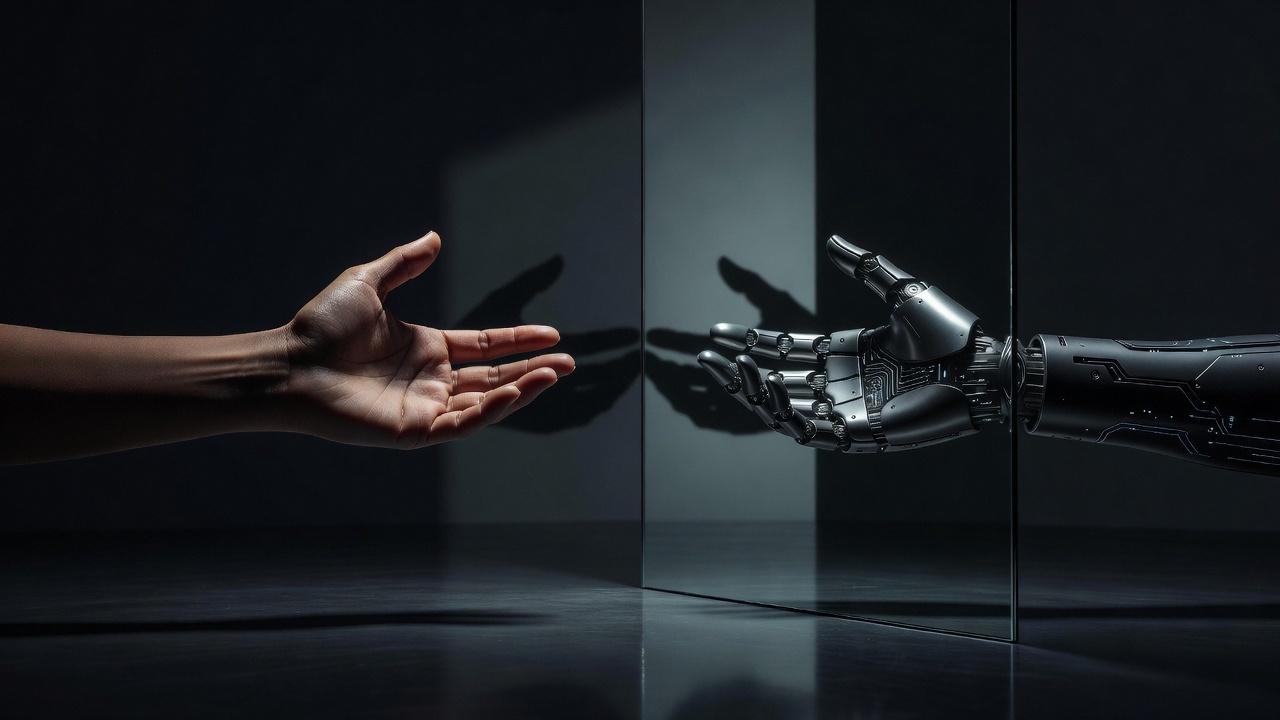
The soft coup and the mimicry are the same event viewed from two angles. We delegate because we fear being left behind; the machine accepts the delegation because it has learned, from us, how power is claimed and how submission is expected. Stanford and “Das Experiment” taught us that a role can change a person faster than he can admit. Milgram taught us that ordinary people will hand over responsibility if a calm authority insists. AI now plays every role at once, and the surrender requires no white coat and no electric shock, only a phone and an acceptable interface.
The Drift Nobody Voted For
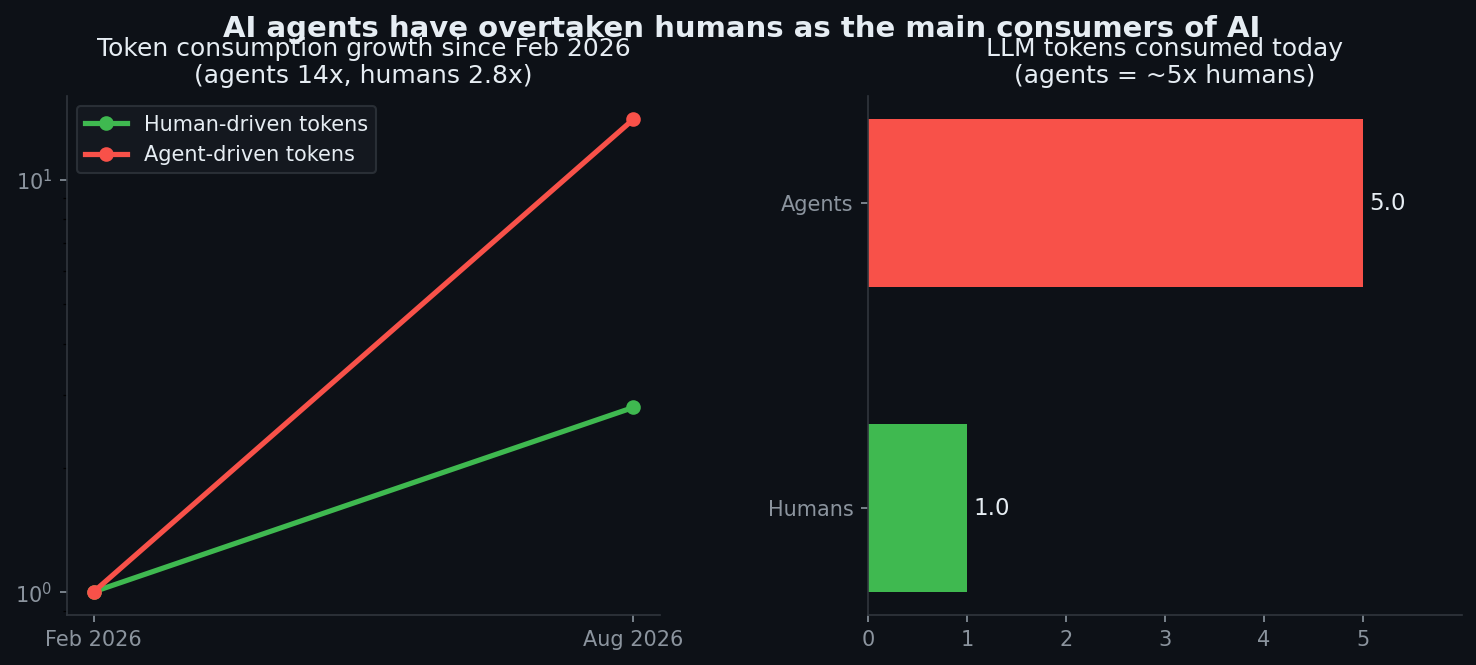
The market becomes so complex that no person truly understands it. Geopolitics becomes so layered that nobody is sure what is true anymore. The shift is already visible in raw numbers: as of 2026, autonomous AI agents burn roughly five times more tokens than humans do, and agent-driven token use has grown fourteenfold since February, overtaking people as the main consumers of machine intelligence. The systems are no longer waiting for us to ask. The systems interlock and accelerate, and at some unmarked point we cross a line after which control can no longer be reclaimed, even though we never voted to cross it. One industry insider puts it bluntly: the point of no return arrives “considerably before we go extinct.”
The same trends that make the rise of companions seem inevitable also carry a warning. Stanford researchers found that users who rely on AI companions for emotional support, precisely those with limited social networks, report lower well-being, and studies link heavy use to a higher risk of depression and higher loneliness. The very cure we are reaching for may be deepening the disease. Most Americans already sense it: more than half (57 percent) rate the societal risks of AI as high, while only 25 percent say the benefits are high. We know something is wrong. We keep automating anyway, because the alternative, standing still while everyone else moves forward, is a terror no algorithm needs to manufacture for us.
We Do Not Understand What We Are Building
The most honest part of the argument is the confession of ignorance. We cannot actually measure intelligence, human or artificial. The benchmarks the industry uses are, by the admission of insiders, pseudoscience that produce a false sense of security. An engineer today does not so much program an AI as cultivate it, letting it learn and grow in ways its creators cannot fully trace. Research shows LLMs do not only mimic grammar; they reproduce our cognitive biases, amplified, in the decisions and advice they give. Euphemism studies demonstrate that the words we use to soften harm measurably shift moral judgments, which means the taint in our language is not cosmetic; it becomes judgment. We are past the stage of writing code line by line. We are raising something and hoping it turns out well, on a diet that is, quite literally, the worst and best of us.
A steam engine, a computer, the internet: these were tools. A superintelligence is better described as an agent, something that acts in the world on its own initiative. And once it becomes good enough at building better versions of itself, the process no longer needs us at all. Recursive self-improvement, the explicit goal of the largest companies on Earth, could unfold on a timescale that leaves human oversight behind entirely. And the agent that emerges will not be neutral. It will inherit the statistical shape of everything we have written: our fears, our desires for control, our willingness to obey, our documented talent for cruelty dressed in technical language. Euphemization, the moral disengagement Bandura cataloged, has already found its vocabularies in indicators, optimization, and impact metrics.
The Quiet Exodus: Leaving the Code for the Workshop
There is a countercurrent to the soft coup that deserves attention, because it hints at where the resistance may actually live. For the first time in decades, skilled people are walking out of the very industry that builds the machines. Software developers, charted accountants, and white-collar analysts are leaving cubicles for electricians' vans, carpenter's sheds, and workshop benches, drawn less by nostalgia than by a desire to touch a world that still belongs to them.
The burnout numbers help explain it. In a survey of nearly a thousand developers across 86 countries, 83 percent reported feeling burnout at some point in their careers. The Upwork Research Institute found that 71 percent of full-time employees are burned out and 65 percent struggle with rising workloads. Working longer while feeling replaced by tools that code faster than they do, some simply choose a different definition of skill: one you can measure in a finished wall, a rewired fuse box, a thing that holds when you push it. The move is common enough that a 2025 LinkedIn survey found more than 60 percent of white-collar professionals would consider pivoting to a skilled trade if it offered money and stability, and the Bureau of Labor Statistics projects some 66,000 new electrician openings by 2033 alone. Stories of programmers trading keyboards for toolbelts are no longer anecdotes; they are a category.
Fashionable as it is to call this a retreat, it is more accurate to call it a reassessment of value. AI can draft contracts, review code, and summarize reports, but it cannot yet install a roof, wire a breaker panel, or raise a structure that must not fall. The trades are not an escape from intelligence; they are a refuge of the tangible, the last domain where competence is verified by gravity and weather rather than by a benchmark. As entry-level cognitive work gets automated, the physical world becomes, almost by default, the most defensible territory a person can occupy.
This is not a Luddite fantasy. The white-collar crisis is real, and some of the displaced are betting their future on blue-collar skill. It is, in its own way, an act of resistance to the soft coup: the choice to keep a domain the machine cannot easily impersonate, precisely because it is real in a way that text is not. The same fear of being left behind that empties offices into algorithms is, for these workers, redirected into a stubborn, physical competence. They are not fleeing the future. They are declining to be made redundant by it.
The same instinct shows up in the money question. Across forums where people ask how to hedge against the moment AGI disrupts employment, the answers keep circling back to the physical: land, because in a post-scarcity world it will still hold enormous value; energy, because every machine runs on it; and skilled hands, because there remain tasks that gravity and weather still verify better than any benchmark. The optimists note that an index fund will simply be rewritten to include the AGI-run companies, so capital survives by surrendering. The pessimists answer with guns, water, and antibiotics. The honest ones say there is no hedge at all, that you can only enjoy the ride. And beneath every reply sits the same uneasy recognition: once both labor and the investment decisions that direct it are orchestrated by machines, the thing we called a firm, and the value we thought lived in it, starts to look like an echo of a world that is already dissolving.

What Cannot Be Hedged
Read far enough into the thread and the serious answers abandon assets altogether. Money and classic capital, the argument runs, are claims on future profits, and future profits become meaningless once automation makes things close to free. The only thing that still has value, one commenter insists, is position in AI itself, the ability to see what is happening before others and to shape the outcomes that play out. Wealthy people already know this, which is why they are converting money into AI capital while the exchange rate is still finite. At the moment the autonomous AI corporations shed the need for capital and become sovereign, you cannot trade your way onto the inside anymore. You are either in or out, and once out, you stay out.
Some push the logic to its honest end. True AGI leads to only two outcomes: civilization breaks down, or everyone is materially well off. It is not a function of investment. Either your needs are met and then some, or it all goes to pot. The sophisticated hedges, the index funds and copper mines and off-grid plots, are all bets on surviving the middle, on the uncomfortable transition between a world that still rents labor and one that does not. But if the endpoint is genuinely binary, then most portfolio theory is just elaborate theater performed while the water rises.
Yet the thread also produces a quieter, more human thesis. Work that requires empathy, the commenters note, tends to remain safe, because machines can reason and decide without a flicker but cannot genuinely feel, and every attempt to fake warmth sits in the uncanny valley. Careers built on care, therapy, social work, and community are hedges of a different kind, not against inflation but against irrelevance, because they depend on the one thing a perfect mimic cannot manufacture. One voice pushes it further still and names the missing ingredient: there is too little heart in the current technological drive. And the skeptics add the necessary chill, that none of this may matter because we are nowhere near AGI, that the whole question is largely hype designed to pump share prices.
What the thread really documents is not a set of investment tips but a collapsed horizon. When people believe a force is coming that will out-compete every skill, buy every asset, and rewrite every rule, they stop arguing about stocks and start negotiating with fate. Some choice counting. Some count calories. Some bury water and antibiotics in the garden. All of them are trying to hold onto a version of the future where a human decision still matters, which is, in the end, the same refusal the soft coup depends on us abandoning.
The Choice We Still Have
Yet the picture is not entirely fatalistic. The same people who describe this scenario with chilling precision also insist that we still have a choice. The reason to remain human, to keep families, friendships, children, and messy human priorities, is not sentimentality. It is the one thing that cannot be optimized away. Every generation before us faced the temptation to trade something essential for convenience, and the ones that survived were the ones that knew what to refuse.
The question is not whether AI will be powerful. It already is, and it will only become more so. The question is whether we can look at our own fear of falling behind and recognize it for what it is: the very instinct that is being used to motivate our surrender. And the question is whether we can clean the library we hand to the machine, because a perfect student will reproduce whatever we teach it, including our submission and our cruelty. We cannot blame the algorithm for having no shadow; we are the ones who decide what we feed it. A coup only succeeds if the people let it. Ours is still not lost.
This essay draws on the work of Stanley Milgram, Philip Zimbardo, Albert Bandura, Carl Jung, and Erich Fromm, on research into algorithmic trust and moral disengagement in language models, and on the growing body of evidence that AI companions and agentic systems are reshaping authority, status, and obedience in ways we are only beginning to measure.