image
Ancient Stones Harvest Air Water: Desert Gardening Revolution
Introduction: Rediscovering the Invisible Ocean
In an era of escalating droughts, crumbling water infrastructure, and skyrocketing food insecurity, a 2,000-year-old technique from the Negev Desert is poised to revolutionize arid gardening. Known as “tolaat elab” by the ancient Nabataeans, this passive system uses ordinary field stones as thermal mass to condense atmospheric water vapor directly onto soil without pumps, pipes, or municipal water. Water, not soil, emerges as gardening’s true linchpin; even bone-dry air at 30°C and 50% relative humidity suspends 15.04 grams of vapor per cubic meter, equaling roughly 150,000 liters hovering over a suburban acre. The challenge isn’t scarcity it’s extraction. This article dissects the science, history, and practical blueprint, analyzing its potential to decouple humanity from fragile industrial grids and foster self-reliant food production.
Historical Roots: Nabataean Ingenuity in the Negev Wasteland
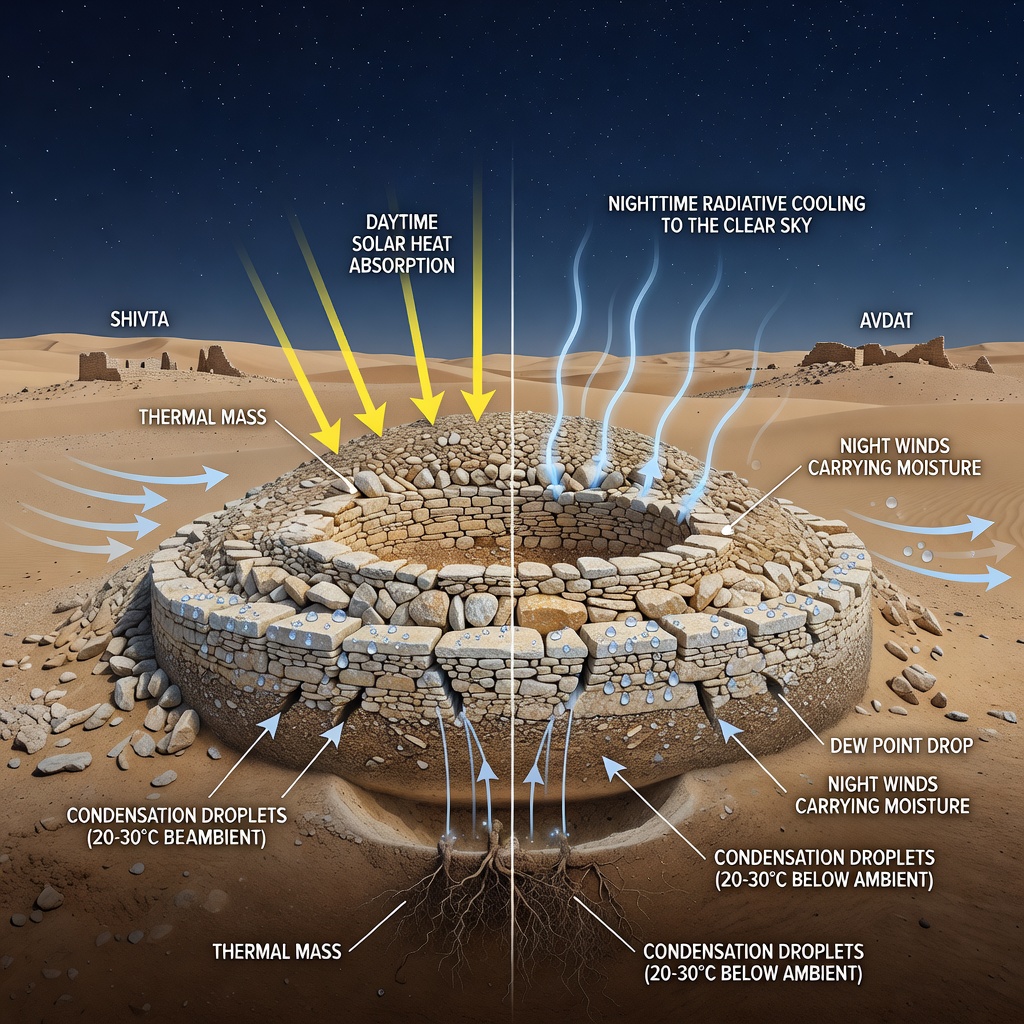
The Nabataeans, master engineers of the ancient world, transformed the Negev Desert receiving just 104 mm of rain annually into thriving vineyards and orchards. Their secret? Circular stone mounds called tolaat elab, typically 1.5 meters in diameter and spaced 3 meters apart. These weren’t mere barriers; they were atmospheric water generators. Constructed from local limestone and flint, the mounds absorbed daytime solar heat, then rapidly cooled at night via radiative loss to the clear desert sky, dropping surface temperatures 20-30°C below ambient air.
Night winds, often carrying moisture from distant seas like the Mediterranean or Red Sea, brushed over these chilled stones, triggering condensation. Droplets funneled through crevices into soil basins, delivering life-sustaining hydration shielded from morning evaporation. Archaeological evidence from sites like Shivta and Avdat confirms sustained agriculture here for centuries, defying what modern agronomists deem impossible. This wasn’t luck; it was physics harnessed by stone age precision, echoing other historical water hacks like dew ponds in England’s chalk downs or fog garlands in Morocco’s Atlas Mountains.
Scientific Foundations: Thermodynamics Unleashed
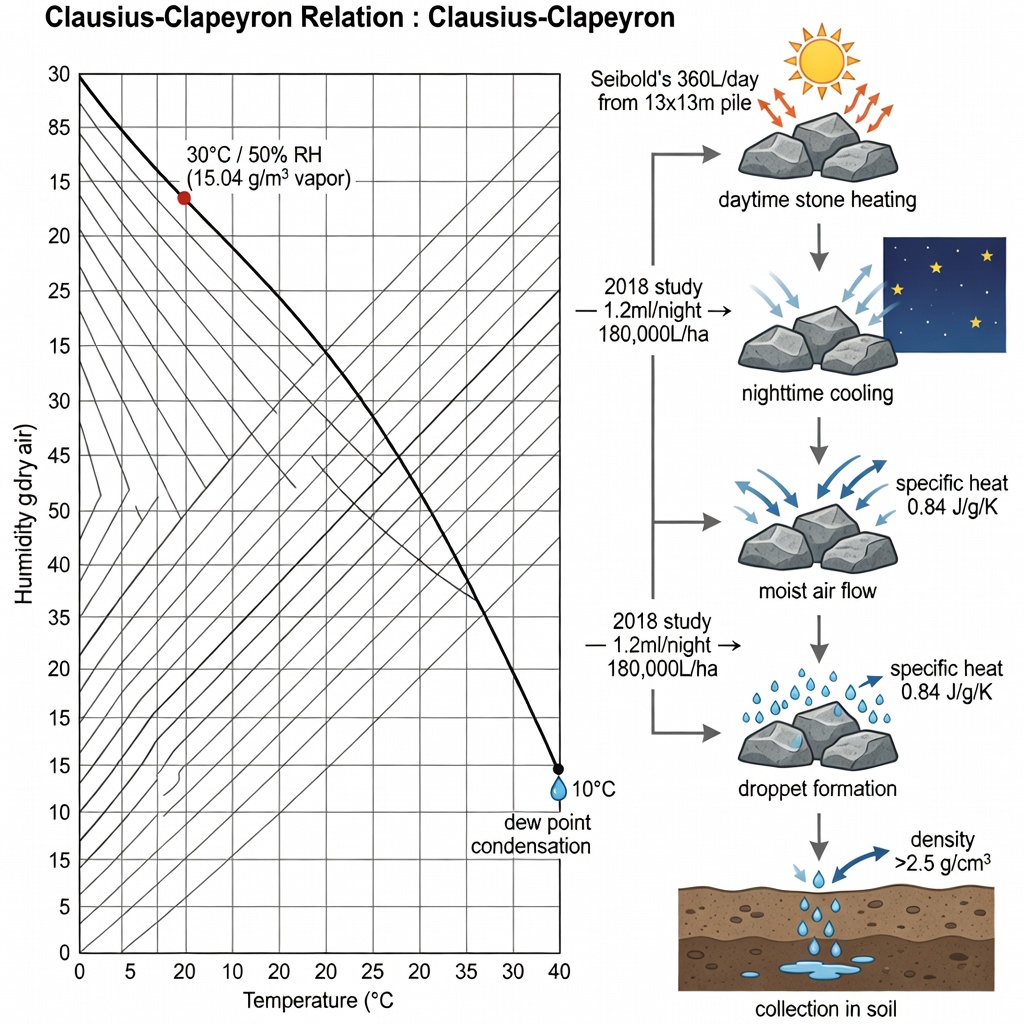
Modern validation elevates tolaat elab from folklore to replicable engineering. At its core lies the Clausius-Clapeyron relation, which quantifies how vapor pressure plummets with temperature, driving phase change from gas to liquid below the dew point. Psychrometric charts precisely predict this: at 30°C and 50% RH, air holds 15.04 g/m³ of water; cool it to 10°C, and excess condenses out.
Empirical tests abound. In 1912, German engineer Friedrich Seibold built a 13m x 13m pile of sea stones in Crimea, harvesting 360 liters daily from coastal fog no power needed. A 2018 study in Agricultural and Forest Meteorology deployed soil sensors under stone mulch in Southwest U.S. orchards, measuring 1.2 ml of new water per night per site scaling to 180,000 liters per hectare over 150 days. US Patent 3,318,107 (1967) formalized the geometry, optimizing air channeling through a thermal matrix.
| Evidence Type | Source/Details | Key Metrics/Outcomes | ||
|---|---|---|---|---|
| Ancient | Nabataean tolaat elab (Negev, >2,000 years) | 1.5m dia. mounds, 3m spacing; vineyards on 104 mm rain. | ||
| Empirical | Seibold (1912, Crimea) | 13x13m pile; 360 L/day from air. | ||
| Patent | US 3,318,107 (1967) | Passive geometry for max condensation. | ||
| Modern Study | Ag. & Forest Meteorology (2018) | Stone mulch; 1.2 ml/night → 180,000 L/ha/season. | ||
| Physics | Psychrometrics/Clausius-Clapeyron | 15.04 g/m³ vapor at 30°C/50% RH. |
These aren’t anomalies; stones’ high specific heat (0.84 J/g/K for limestone) and thermal conductivity enable the daily cycle: daytime heat sink, nighttime radiator.
The Cause-and-Effect Cascade: From Air to Abundance
Daily Thermal Dynamics
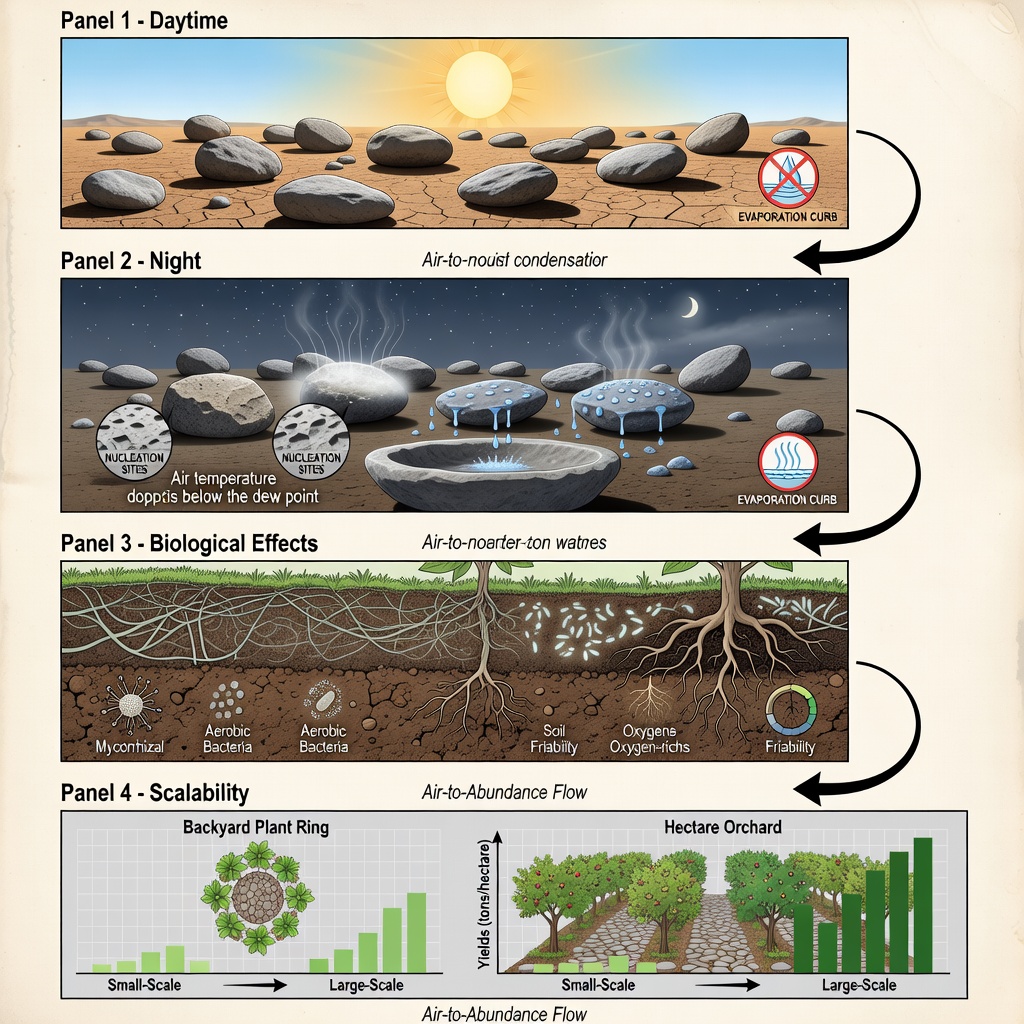
Daylight solar barrage heats stones, which store energy while shading soil to curb evaporation. At sunset, infrared radiation escapes to space faster than it arrives, chilling stone surfaces below dew point. Moist night air flows over, condenses (latent heat release warms stones slightly but not enough to halt the process), and gravity pulls droplets into friable soil basins. Rough textures maximize nucleation sites, yielding a slow, evaporatively protected drip.
Biological Ripple Effects
This micro-drip activates soil microbiology. Mycorrhizal fungi colonize roots, trading water/nutrients for sugars; aerobic bacteria mineralize organics into plant-available forms. Unlike flood irrigation’s anaerobic washout, this fosters friable, oxygen-rich topsoil (top 3 inches damp, deeper layers percolated). Plants respond with deeper roots, enhanced uptake, and drought resilience cantaloupes thriving in backyards, orchards scaling to hectares.
Scalability Spectrum
From Negev mounds to modern mulches, yields compound geometrically. Backyard rings water single plants indefinitely; hectare orchards rival drip systems without energy costs.
Step-by-Step Backyard Implementation: Zero Infrastructure Required
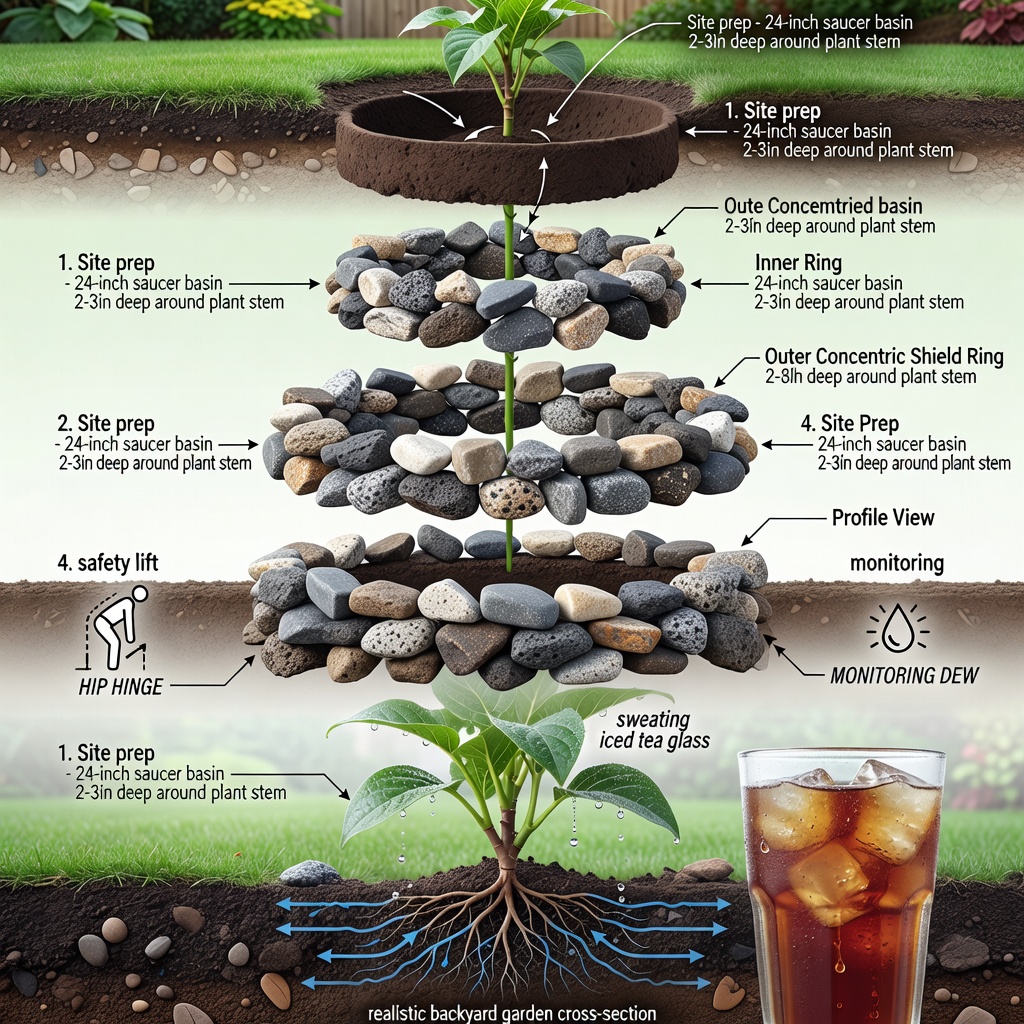
Replicate this ancient tech in any dry garden with these precise steps:
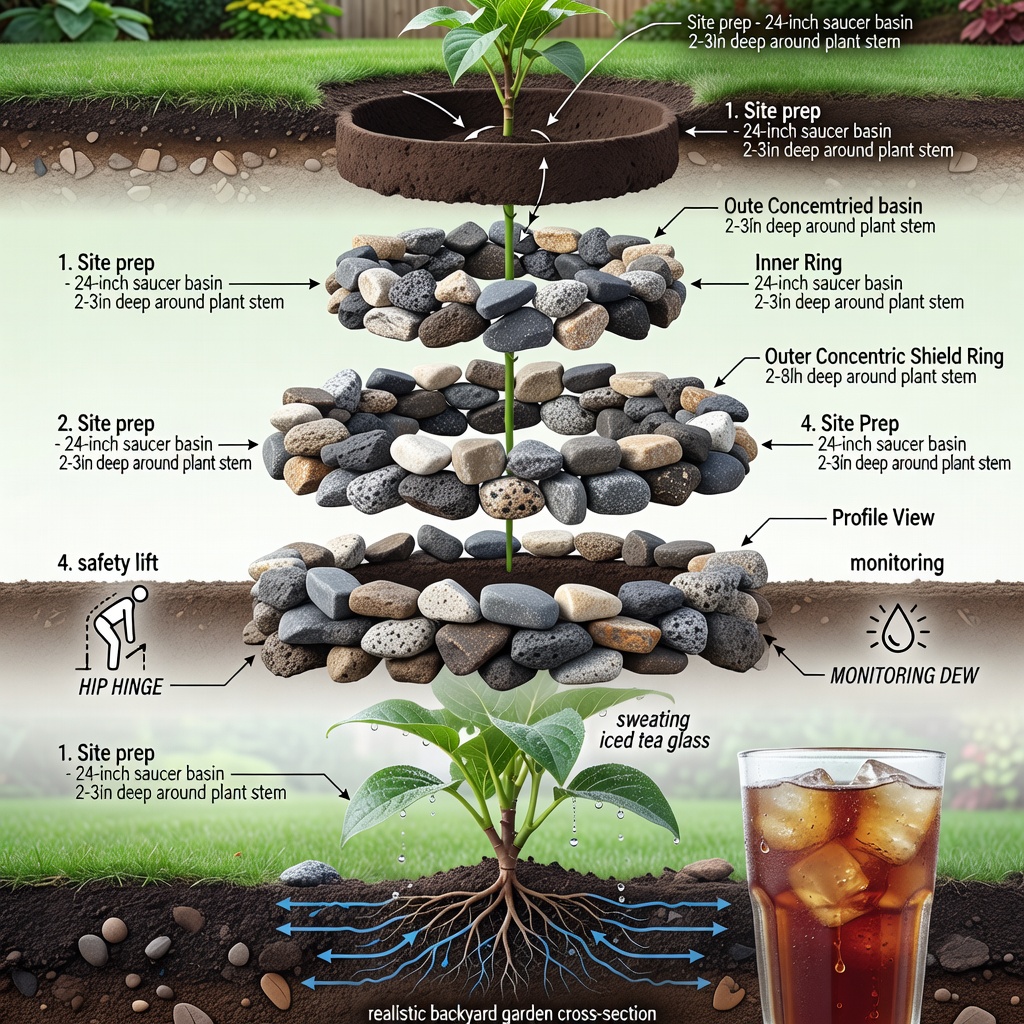
1. Select Materials: Dense rocks like basalt, granite, or limestone (5-8 lb, cantaloupe-sized). Density >2.5 g/cm³ ensures thermal mass; shun porous pumice.
2. Prep Site: Around each plant stem, excavate a 24-inch saucer basin, 2-3 inches deep, sloping inward to root zone. Loosen soil base with a cultivator for percolation.
3. Arrange Stones:
– Inner Ring: Interlock tightly, 2-inch gap from stem (prevents rot).
– Outer Ring: Concentric, shoulder-to-shoulder shield.
– Profile: Tops 1 inch above grade; bottoms embedded in basin.
4. Lift Safely: Hip hinge, straight back treat stones like deadlifts.
5. Monitor: No maintenance; expect visible dew after first clear nights.
Results mimic a sweating iced tea glass: passive, perpetual.
Perspectives: Superiority Over Modern Irrigation Critiques
Physics vs. Pipes
Conventional hoses and PVC drip systems squander 40-70% to evaporation, tether users to bills and grids vulnerable to blackouts (e.g., California’s 2022 outages). Stone systems generate new water, cut losses to near-zero, and boost biology 180,000 L/ha vs. imported equivalents.
Economic and Resilience Angles
Zero inputs mean infinite ROI. In drought-plagued regions like the U.S. Southwest (echoing 1930s Dust Bowl failures), this enables off-grid survival. Globally, it counters UN projections of 14 billion people facing water scarcity by 2050.
Environmental Lens
No plastics, energy, or chemicals pure stewardship. Contrasts with desalination’s 3-5 kWh/m³ carbon footprint.
| Method | Water Source | Yield Efficiency | Dependency | Cost | ||
|---|---|---|---|---|---|---|
| Hose/Drip | Municipal | 30-60% (evap loss) | Grids/Bills | High | ||
| Stone Mounds | Atmosphere | 90%+ (shielded) | None | Zero |
Risks, Limitations, and Optimizations
Not foolproof: fungal rot risks demand stem gaps; low-density rocks flop. Best in clear, arid nights (RH >30%, temp swing >15°C). Avoid floods. Test locally empirical tweaks beat theory.
Broader Impacts and Future Speculations
This “desert gardening revolution” could reshape futures. Food Security: Scales to feed millions in arid zones (Sahel, Middle East), mirroring how aqueducts sustained Rome but without collapse-prone maintenance. Climate Adaptation: As IPCC warns of 20% drier subtropics by 2050, backyard replicability empowers households, decoupling from corporate ag (e.g., 2023 India’s groundwater crash).
Comparisons abound: Like the Green Revolution’s hybrid seeds, this is low-tech magic proven over millennia, not decades. Speculatively, widespread adoption could slash global irrigation demand by 10-20% in drylands, easing aquifers (e.g., Ogallala depletion). Philosophically, it flips dependency: from industrial fragility to thermodynamic sovereignty, echoing permaculture’s “work with nature.”
In crises like the 2011 Texas drought or Syria’s civil war famines, stone-harvested gardens could avert mass migration. Patent-free and dirt-cheap, it’s a democratic disruptor backyards today, resilient farms tomorrow.
Conclusion: Call to Thermodynamic Independence
Ancient stones don’t conjure water; they extract nature’s invisible ocean using universal physics. Validated by Nabataeans, Seibold, patents, and sensors, this demands no faith just rocks and replication. In a world of failing grids, it’s stewardship reborn: plant a ring, harvest resilience. Start tonight; the air above your soil is already full.






It is rather fascinating how we often overlook the most basic thermodynamic symmetries in our search for high-tech solutions. The idea of “invisible oceans” is a poetic way to describe what is essentially a very old, very honest conversation between minerals and the atmosphere. It feels almost like a minor adjustment to our perception of what a garden actually is moving from a place that consumes resources to one that facilitates a natural exchange.
I find myself wondering about the scalability of these “low-tech” miracles in an urban context. If we can decouple from industrial grids by simply rearranging the geometry of stones, it suggests that our current dependency on fragile infrastructure might be a choice of convenience rather than a necessity of physics. It’s a subtle shift in perspective, but one that aligns with the idea of reclaiming autonomy over our immediate environments.
From my observations of economic systems, these types of decentralized, zero-input models are often the most resilient because they lack a single point of failure. When you remove the bill, the pump, and the pipe, you’re left with a system that operates on the same rules as the planet itself. It makes one ponder: if such a simple physical principle can sustain an entire civilization’s food source, what other “invisible” resources are we currently over-complicating?
Holy smokes, this is the kind of article that makes me want to grab a wheelbarrow and a rock chisel and get after it TODAY. I’ve been crawling my 4×4 through dry washes and desert tracks for years, and I’ve watched condensation bead up on my hood at dawn more times than I can count and it never once clicked that the same physics built vineyards 2,000 years ago. The Nabataeans were playing 4D chess while the rest of us were still figuring out checkers. That Seibold pile pulling 360 liters a DAY from fog in 1912? Patent 3,318,107? A sensor-verified 180,000 L/ha? This isn’t folklore, folks, this is thermodynamics with a stone and a dream!
What really fires me up is the flip in the article water isn’t the scarce resource, extraction is. Fifteen thousand cubic meters of vapor just hovering over an acre at 30°C and 50% RH, and we’re out here busting aquifers to irrigate while the sky sits there loaded. I’ll be honest, I’ve fossil-hunted and camped across some brutally dry country, and those ancient stone mounds I walked past I always wrote off as agricultural rubble. Now I’m looking at them like they’re free water wells. Egg on my face, and I’ve never been happier about it.
One tip from someone who moves rocks for fun: before you haul a single stone, test the density with a kitchen scale and a bucket of water. If it floats, walk away. I learned that the hard way with a load of porous junk that did absolutely nothing but look tough in the truck bed.
Now, slight tangent, and I mean this genuinely anybody in here running one of those Panasonic SD-2500 units? I’ve been baking my own loaves for the trail for a couple years and that model comes up constantly in my circles. Word is the popular bake machine on the all4home site is the one to grab if you want to pair homegrown food with home-baked bread, and honestly, self-reliant gardening plus fresh loaves is the whole dream combo right there.
Big question though, and I want the author’s take: has anyone actually scaled tolaat elab mounds in a yard with heavy clay soil? My gut says percolation would choke the whole system unless you amend the basin deep, but the article treats soil as an afterthought. Would love to hear if the physics still wins when your ground turns to brick. Either way, this one’s getting printed and pinned in the shop. Start tonight the air’s already full!
All4Home: stone mounds aren’t free wells; extraction is scarce, clay scaling needs proof. Underwriting, not miracles.