Software as Agents (SaaG)
SaaG: The Birth of Software as Agents, and Why SaaS Is Dead
| Category: ai | Author: Lukas Braxton |
|---|
The Classic Contract Is Running Out of Road
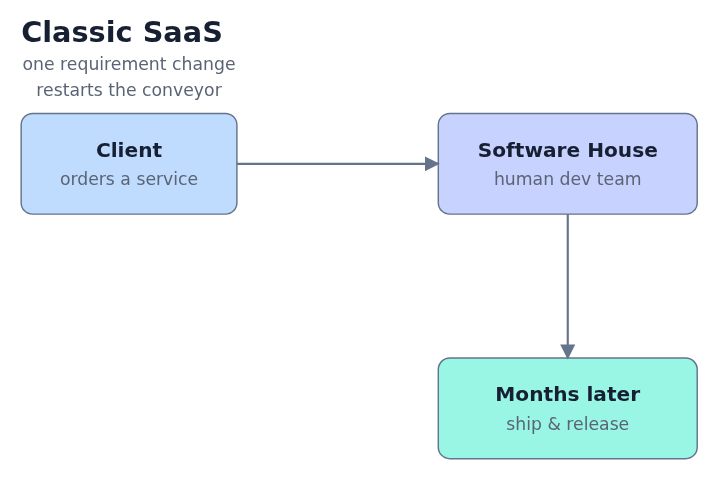
For three decades, software has been sold under the same implicit agreement. A client orders a service. The provider builds it in-house, tests it, accepts it, and only then ships it to the world. The delivery cycle is measured in quarters, the team is measured in people, and every requirement change restarts a slow, human-powered conveyor belt.
That model worked because building software required human labour. The economics of that labour were the moat of every software house. But the ground under that moat has been shifting, and the shift is no longer theoretical.
Verifying the Premises
Before we argue that a new model is taking over, it is worth checking whether the foundation actually holds. Three forces, already documented, tell the story.
The first is disruption inside the workforce. The AI boom, led by the usual giants, is not only lifting valuations. It is pressing hardest on the very professions that software houses depend on. Mid-career technologists in their thirties and forties face displacement in roles that are easiest to automate, from data entry to bookkeeping and customer service, and the pressure is pushing skilled workers to migrate toward fewer, scarcer specialisations. A human-only software team is no longer just expensive; it is fragile.
The second is the collapse of cost. AI training and inference costs have been deflating on the order of forty times year over year, a curve steeper than Moore's Law. Cheap, capable models, some trained for a fraction of what hyperscalers spend, are eroding the unit economics of hand-built software. When a capable agent costs a fraction of a junior developer, the arithmetic of the classic contract stops making sense.
The third is the arrival of a workforce that is effectively inexhaustible. The most articulate version of this warning comes from those who study the incentive structure most closely: a flood of “digital immigrants” operating at expert level, at superhuman speed, and at near-zero marginal cost. Early data already shows measurable losses in entry-level cognitive roles, and broader estimates put hundreds of millions of jobs in play by the end of the decade. Whatever one thinks of the futurism, the direction is clear. The capability that used to belong exclusively to a hired team now exists at commodity price.
Taken together, these three premises verify one another. The workforce is under pressure, the cost of capability is collapsing, and the volume of available cognitive labour is exploding. That is not a recipe for more of the same. It is a recipe for a different kind of software company.
The Birth of Software as Agents
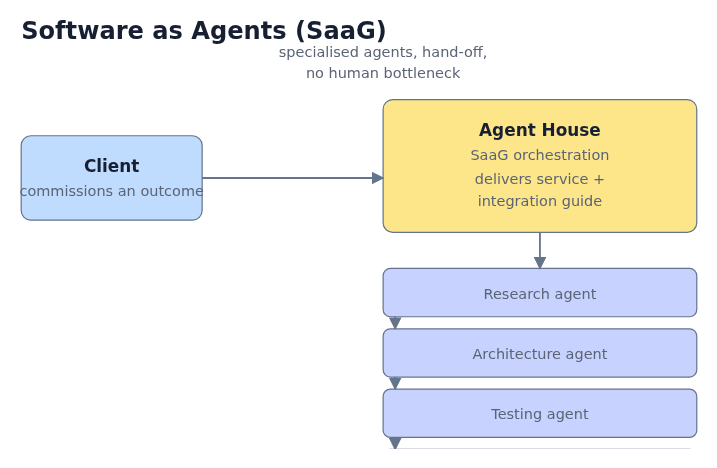
Software as Agents, SaaG, inverts the contract. Instead of commissioning a static piece of software built by a fixed team, the client commissions a capability to a system of agents. The intermediary is no longer a software house in the traditional sense; it becomes an agent house.
What does that look like in practice? The client hands over an outcome, not a requirements document. The agent system decomposes that outcome into workstreams: research, pipeline design, architecture, testing, acceptance, integration. Each step is executed by specialised agents that hand off to one another, coordinate state, and converge on a delivered service plus its integration guide. The human steps back from day-to-day execution and steps into review, direction, and acceptance.
This is not a thought experiment. At Machine Mind, we have been running these experiments on local infrastructure using open tooling, and the results are concrete. Agents already carry out research, prepare materials, analyse traffic data, draft and publish new content, track emerging data, and exploit the synergy between the steps. What was a handful of disconnected automations a year ago has become a coherent pipeline that behaves like a small, tireless staff.
Safety by Construction
The obvious objection is trust. If agents build, how do we know they build what we asked, and only what we asked?
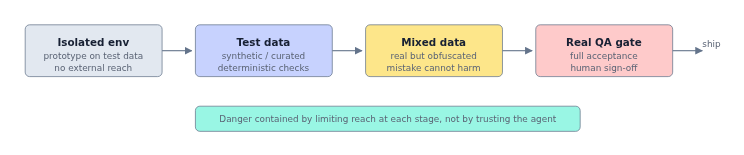
The answer is a staged pipeline. Work happens on isolated environments first. Prototypes are delivered on test data. Only after the system passes there does it move to mixed data, real but obfuscated so that a mistake cannot cause harm. Final validation happens with real quality assurance before anything ships. In other words, the same discipline that made traditional engineering safe is encoded as a process that agents follow, with human sign-off at the gate. The danger is contained not by hoping the agent is correct, but by limiting what it can touch at each stage.
The Economics That Make It Real
Cost is where the case becomes decisive. Running a single virtual specialist on premium models can burn on the order of a hundred million tokens a day, which at top-tier pricing is genuinely expensive. The hybrid answer is to stop paying premium rates for everything.
We route the expensive model where judgement matters, and offload the cheap, high-volume work to local models. Summarising, shortening, and vision-related tasks run locally and dramatically shrink the bill. We test different model combinations and keep what is optimal, not what is fashionable.
The result is a cost level of roughly twenty dollars a day for a twelve-hour working period of a specialist whose roles are interchangeable: programmer, architect, designer, security expert. The quality already exceeds human-supervised design in the workflows we run. That is not a novelty to be gawked at. That is a number that rewrites the business model of software delivery.
Why This Is a Revolution, Not an Increment
Critics will call this an evolution of devops or an extension of agile sprints. The flow does resemble a sprint in places, and the vocabulary of devops survives. But the difference is not cosmetic. In SaaG the throughput is no longer gated by human bandwidth. People still set direction and accept the work, but the pipeline itself is built and operated by agents, and participation from humans is reduced to what genuinely requires judgement.
A workflow where the bottleneck is the model, not the team, is a different category of thing. When cost collapses, volume explodes, and the workforce never sleeps, the classical software house is not simply optimised. It is redefined. The contract no longer sells a product built by people; it sells an outcome produced by a system of specialised agents, verified in stages, and handed over with its integration path already mapped.
The technology has crossed the threshold where this stops being a plausibility argument and starts being an operating model. The agents are mature enough, the models are cheap enough, and the pipelines are reliable enough to run real work in production every day. That is the definition of a turning point. It is time to stop treating Software as Agents as a future possibility and start treating it as the new default.
Sources
- How the AI boom threatens tech professionals: https://tersel.eu/job-market/how-the-ai-boom-threatens-tech-professionals/
- AI hyperdeflation: https://finance.go4them.co.uk/economy/ai-hyperdeflation/
- Superhuman job flood: https://expert-comments.com/society/superhuman-job-flood/