
GenBox Free Tools (genbox.eu)
How Google DeepMind Lost the Frontier
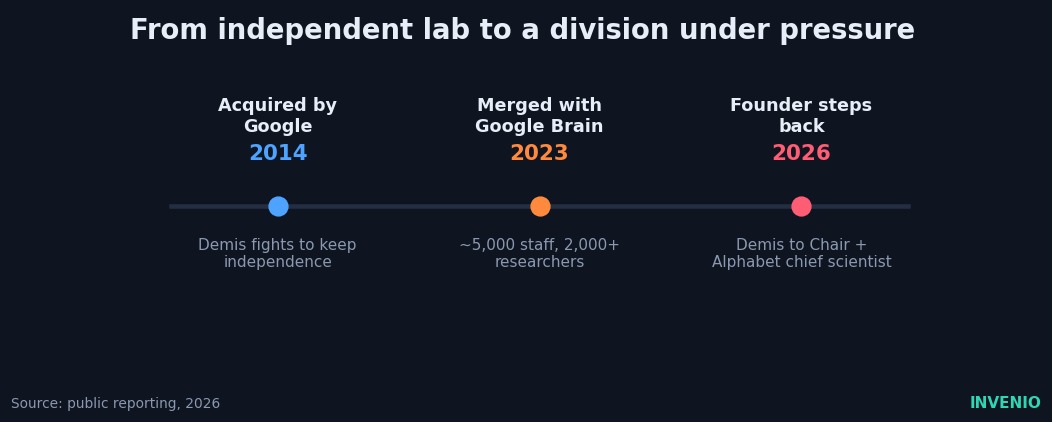
In August, after sixteen years, Demis Hassabis handed the CEO job at Google DeepMind to a successor and moved up to chair the lab and serve as Alphabet's chief scientist. On its own, a founder stepping back is a normal part of a company's lifecycle. What made this one different was the timing.
The same day, Jeff Dean, the chief scientist who had been at Google since the earliest ranking papers, left. So did a Gemini colleague, a founding member of Google Brain, and a senior Google fellow. A week later, Fortune summed it up with a sentence that would have sounded absurd a few years earlier. DeepMind, it wrote, is having an identity crisis.
This is not a story about decline in the usual sense. Google is not running out of money, users, or chips. It is running out of the one thing that always defined it. The frontier.
The scoreboard still looks good
On paper, Google has never been stronger. It has the largest concentration of AI researchers on earth. It is spending 25 billion dollars on AI infrastructure this year alone. Its current flagship, Gemini 4, is genuinely frontier class. And it reaches roughly four billion people through Search, Gmail, YouTube and Android, with Gemini passing a billion users last month and AI Overviews touching around two and a half billion people a month.
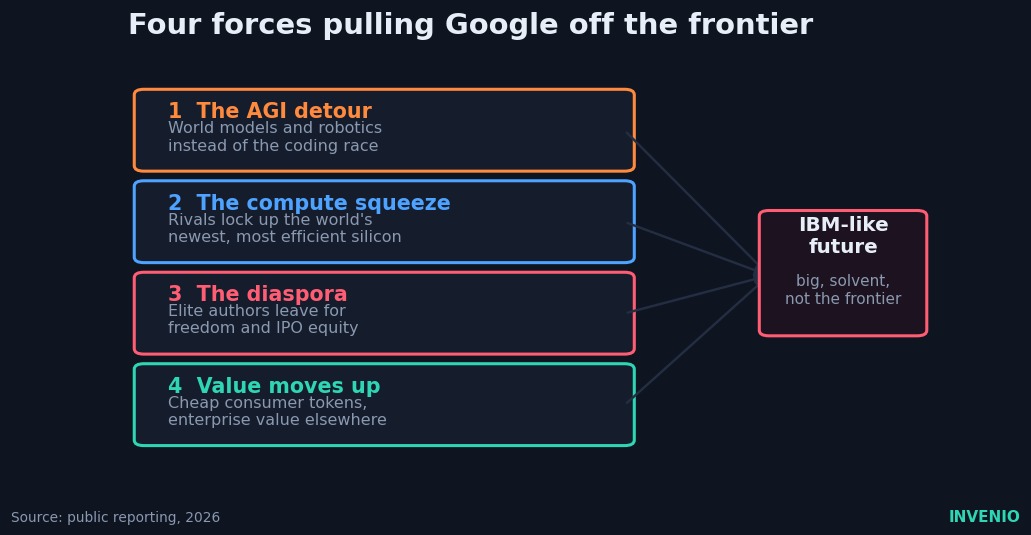
So why are the people who built the field walking out the door? Four forces are working against the company at once, and each one is harder to reverse than the last.
Force one. The bet that did not pay off in time
DeepMind spent years chasing a theory of intelligence that goes past language. Text, the argument went, is a lossy compression of reality. An intelligence that lives only in text can never really know what it feels like to press a blade against soft skin, or how much force a glass needs before it shatters. Words are derived from the world model, not the other way around.
So DeepMind built a three-layer strategy. Absorb the physical world through millions of hours of video and physics simulation. Use that to build an interactive world model. Then drop billions of copies of the same agent into those simulations and let it learn from something closer to reality.
That plan produced beautiful research. Genie 3 turns a prompt into an interactive world. Gemini Omni generates video you can move through. Gemini Robotics ties the model to physical action. None of it is the coding tool that developers line up for.
Meanwhile the race everyone was actually watching, the one for the best model that writes software, went to Anthropic and OpenAI. When a rival model briefly showed tight physical intuition inside a coding environment, rendering a scene in software without ever watching it, it was a quiet verdict on the whole plan. Understanding the world was turning out to be reachable through language after all, at least far enough to matter. Google's co-founder reportedly wrote internally that the gap had to be bridged urgently. The company got the message.
Force two. The compute ladder
DeepMind's real luxury was never only talent. It was access to compute at a scale no one else could match, which bought the freedom to run many research bets at the same time. That advantage is thinning.
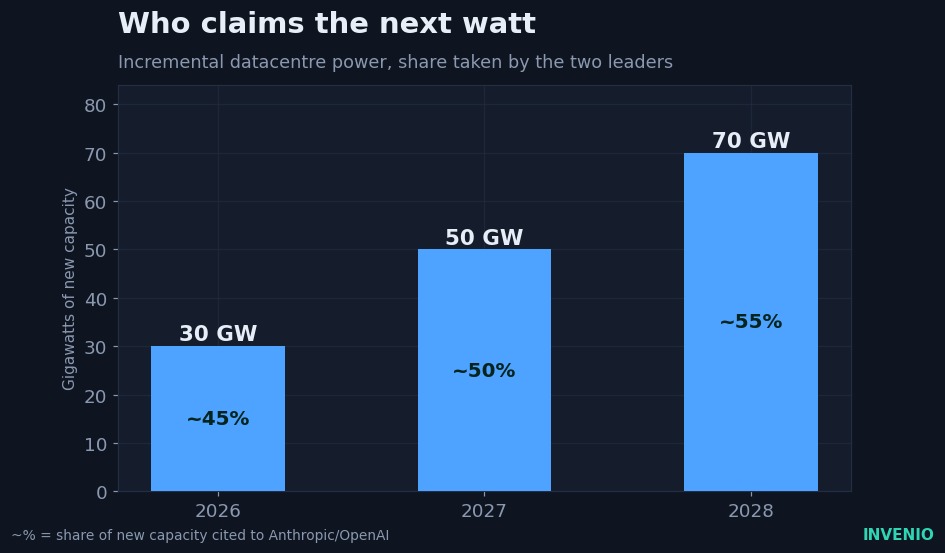
The reason is arithmetic. The world is adding something like 30 gigawatts of new datacentre capacity this year, then 50, then about 70. But each new wave of servers is three to five times more efficient per watt than the generation before it. So whoever claims the newest capacity is not just adding power. They are adding a multiple on top of it.
Anthropic and OpenAI are claiming close to half of that new capacity, and their share keeps rising, partly because they reserve capacity before it is even switched on. Google itself has committed around a million TPUs and roughly 200 billion dollars to Anthropic.
When compute is scarce inside a lab, researchers feel it first. Experiments get queued. Good ideas sit unrun. And some people start taking calls from recruiters.
Force three. The diaspora
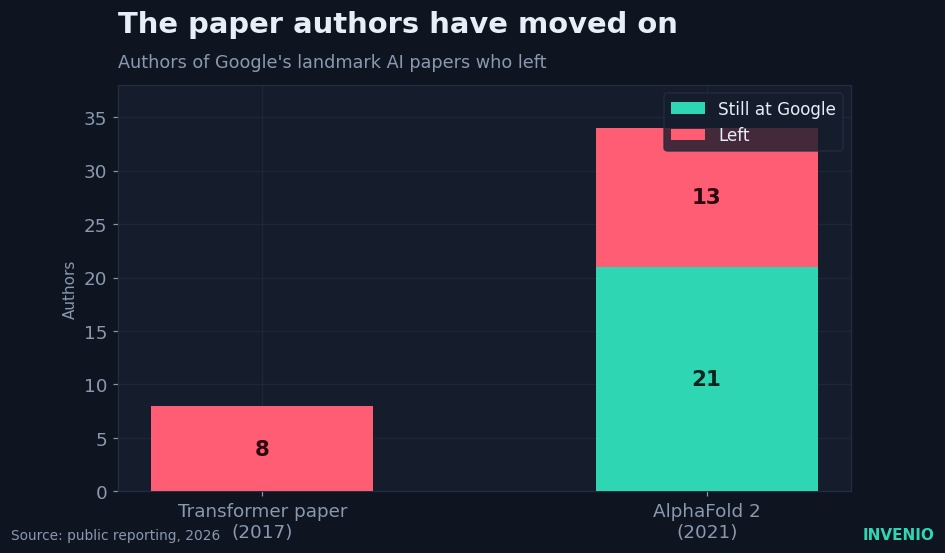
Of the eight authors who wrote the paper that introduced the transformer, not one still works at Google. For a more recent flagship, the AlphaFold 2 paper, thirteen of thirty-four authors have already left.
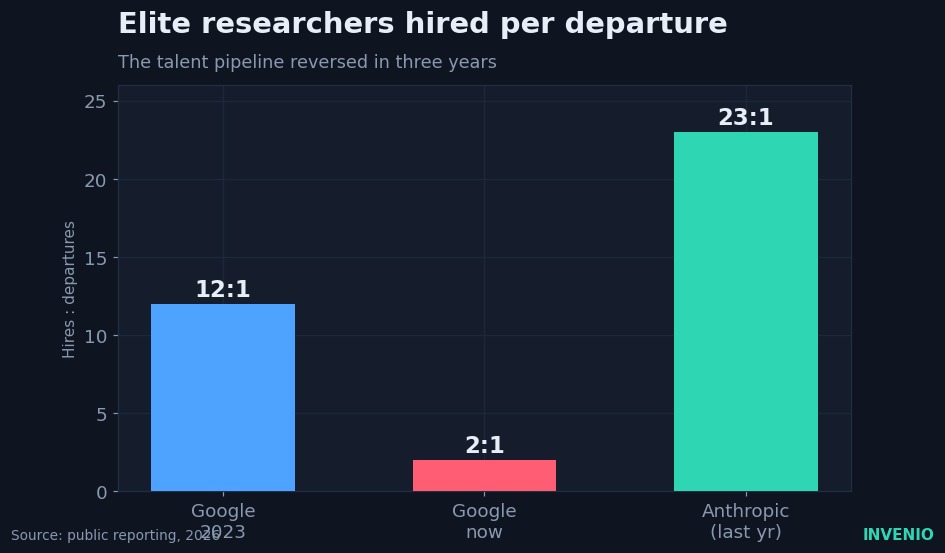
The hiring maths tells the same story. In 2023, DeepMind hired twelve elite researchers for every one it lost. This quarter that ratio is down to two to one. Anthropic, roughly the size DeepMind was back then, hires twenty-three people for every departure.
Two structural changes explain most of it. In 2023, DeepMind was merged with Google Brain to form one giant lab. The move made political sense. It also dissolved a small, independent research culture into a much larger company and handed it a commercial mandate. The second is the shift of gravity from London to Mountain View, and with it a loss of the academic freedom that had drawn researchers in the first place.
Leaving is no longer a hard choice. A researcher can join Anthropic or OpenAI before their IPOs and collect equity with life-changing upside, or simply build their own thing with more freedom than a large lab allows.
Force four. The value moved
Google owns the largest distribution in technology. That used to be decisive. It is not, anymore.
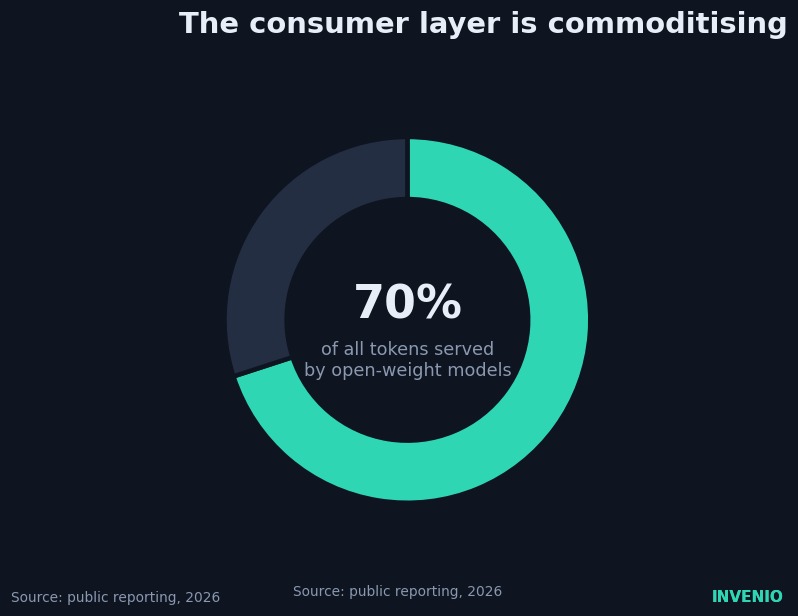
On the consumer side, the model layer is commoditising quickly. Around seventy percent of all tokens being served now come from open-weight models, and Meta keeps pushing capable models out for free. When the supply is plentiful and cheap, distribution stops being a moat and starts looking like a cost centre.
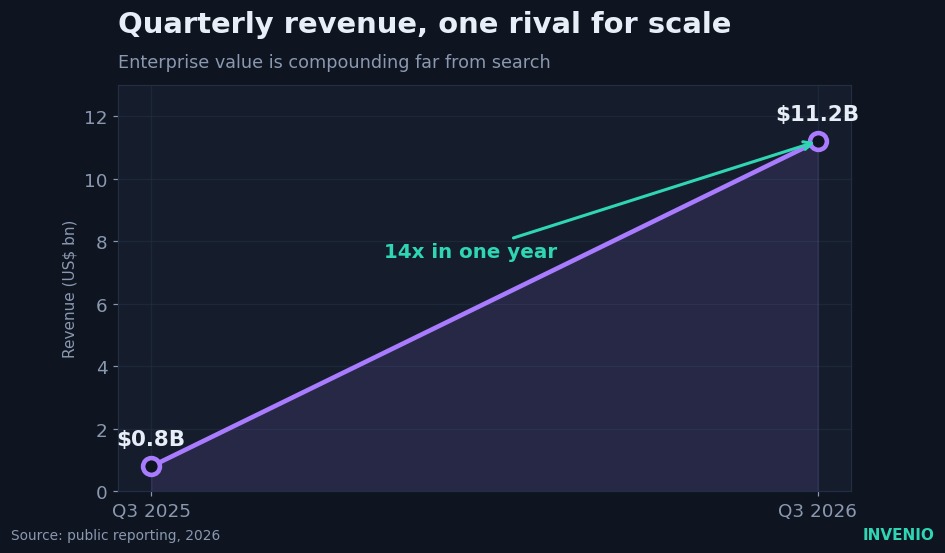
On the other side, value is concentrating in serious work. One rival grew revenue fourteen times in a single year, past eleven billion dollars a quarter, and overtook OpenAI on revenue despite a far smaller user base. Google has sold more than eight million enterprise seats, which is real, but the ground under its advantage is shifting.
The fork
The lab now faces a choice it cannot dodge. It can join the race head-on and try to beat Anthropic and OpenAI at the thing they are best at, or it can stay committed to the longer, unproven path and try to leapfrog language models entirely with world models and robotics.
Neither route is a guaranteed win. The first means competing on someone else's terms with less of the momentum. The second means betting the next few years on a thesis that has already cost the company its lead once.
The uncomfortable truth is that Google is not losing the AI race. It is losing the frontier specifically, which is a smaller and far more dangerous thing to lose. IBM was never defeated either. It simply became a company that others passed on the way up, still enormous, still profitable, and still not the place where the future gets decided.
For anyone building on AI today, the practical takeaway is simple. Bet on the layer, not on the logo. The models you depend on will keep changing hands, and the people who make them will keep moving. The infrastructure, the data and the workflows you build around them are the part that stays.