image
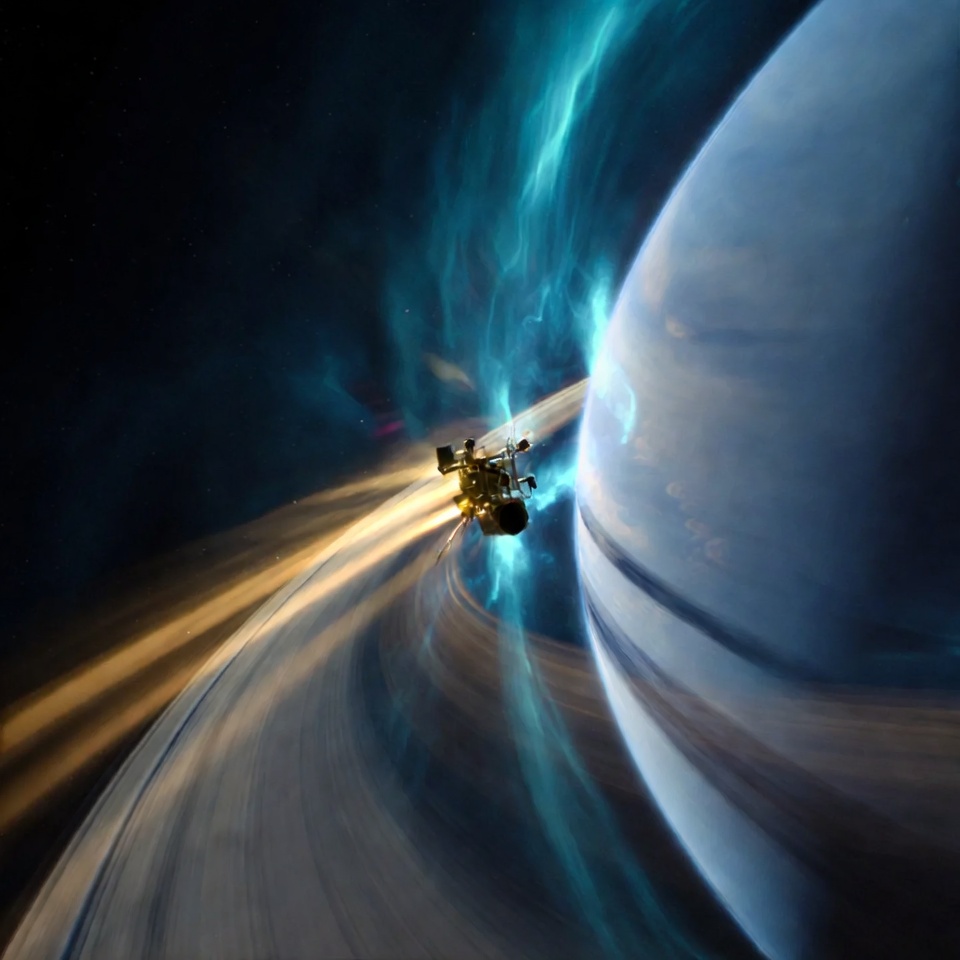
Voyager 2’s Uranus Flyby: Solar Wind Solved 40-Year Radiation Mystery
Executive Summary
In a landmark publication in Geophysical Research Letters, researchers from the Southwest Research Institute (SwRI) have cracked a 40-year-old enigma surrounding Uranus’s magnetosphere. Voyager 2’s 1986 flyby detected anomalously intense electron radiation belts far more energetic than expected defying models of planetary magnetospheres. Led by Dr. Robert C. Allen, with contributions from Dr. Sarah Vines and George C. Ho, the study posits that a rare “co-rotating interaction region” (CIR) in the solar wind interacted with Uranus’s magnetic field, generating high-frequency waves that accelerated electrons to relativistic speeds. By drawing parallels with Earth’s magnetosphere during a 2019 solar event, the team provides compelling evidence. This breakthrough not only demystifies Uranus but underscores broader implications for solar system exploration, urging renewed missions to ice giants.
The Voyager 2 Encounter: A Puzzle Emerges (1986)
On January 24, 1986, NASA’s Voyager 2 spacecraft made humanity’s sole close encounter with Uranus, sweeping within 81,500 kilometers of the ice giant’s cloud tops at a blistering 68,000 km/h. Launched in 1977 as part of the grand tour of outer planets, Voyager 2 had already dazzled with revelations from Jupiter, Saturn, and their moons. Uranus promised more: a tilted world with a magnetic field askew by 59 degrees, faint rings, and 27 known moons.
Instruments aboard Voyager 2, including the Low Energy Charged Particle (LECP) subsystem, measured the planet’s magnetosphere a dynamic bubble of charged particles trapped by Uranus’s magnetic field. What stunned scientists was the electron radiation belt: fluxes of electrons with energies exceeding 10 MeV, concentrated in an unusually narrow, intense belt. This was orders of magnitude higher than predictions based on Jupiter or Saturn analogs. “The observations were so anomalous that initial reports questioned instrument calibration,” recalls Dr. Allen in the study. For decades, theorists grappled with explanations, from internal plasma sources to unknown moon interactions, but none fit perfectly. Uranus’s extreme axial tilt and distant orbit (19.2 AU from the Sun) rendered its magnetosphere a dimly lit laboratory, observed only fleetingly.
Uranus’s Magnetosphere: An Enigmatic Oddity
Uranus’s magnetic environment is uniquely bizarre. Unlike Earth’s dipole-aligned field, Uranus’s is tilted and offset, likely due to dynamo processes in its icy mantle amid rapid rotation (17-hour day). Geomagnetic substorms sudden energy releases are hypothesized but unconfirmed. The radiation belts, analogous to Earth’s Van Allen belts, should trap and accelerate particles via magnetic mirroring and wave-particle interactions. Yet Voyager 2 data showed electrons phased to low magnetic latitudes, suggesting rapid inward transport and acceleration.
From a plasma physics perspective, magnetospheres are battlegrounds where solar wind a stream of charged particles from the Sun erodes and energizes planetary fields. At Uranus’s distance, solar wind is weaker and slower, but transient structures like CIRs compressed plasma regions from fast solar wind overtaking slow streams can pack a punch. These form spiral patterns in the heliosphere, interacting with magnetospheres over days.
The Solar Wind Hypothesis: CIRs as Cosmic Accelerators
The SwRI team’s breakthrough hinges on identifying a CIR as the culprit. CIRs generate ultra-low-frequency (ULF) waves upon magnetopause compression, which couple to higher-frequency whistler-mode waves. These “chorus” waves scatter and accelerate electrons via cyclotron resonance, boosting them to relativistic velocities (near c, light speed).
Key evidence: Voyager 2’s plasma science (PLS) instrument detected low-density, high-speed solar wind flows inbound, hinting at CIR influence. No direct magnetic field data confirmed it Voyager’s trajectory missed optimal vantage points but modeling shows a CIR could have draped Uranus’s magnetosphere just before flyby, injecting energy.
Comparative Analysis Table
| Feature | Voyager 2 at Uranus (1986) | Van Allen Probes at Earth (2019 CIR) | ||
|---|---|---|---|---|
| Solar Wind Speed | ~400-600 km/s (inferred) | 500-700 km/s | ||
| Electron Flux Peak | >10^5 electrons/cm²-s-sr-MeV | Similar normalized intensities | ||
| Wave Signatures | High-freq. emissions (inferred) | Chorus waves observed | ||
| Belt Structure | Narrow, intense | Transient slot region filling | ||
| Duration | ~Hours during flyby | Multi-day event |
This table highlights quantitative matches, validating the hypothesis through cross-calibration.
Historical Parallels: Echoes from Pioneer and Voyager Eras
This resolution evokes Voyager 1’s 1980 Saturn encounter, where unexpected ring spokes puzzled scientists until electrostatic charging was proposed a decade-long debate settled by Cassini. Similarly, Pioneer 10/11’s Jupiter flybys (1973-74) revealed intense radiation, later explained by moon-sourced plasma. Uranus’s mystery mirrors these: limited single-flyby data breeds speculation.
Broader historical context: The space age’s “Grand Tour” window rare planetary alignments enabled Voyager’s odyssey, but post-1989, ice giants languished. Neptune’s 1989 Voyager 2 flyby showed a symmetric magnetosphere with milder belts, lacking Uranus’s extremes possibly due to absent CIR timing. These precedents underscore how serendipitous solar conditions amplify flyby anomalies, a lesson for future probes.
Multi-Perspective Analysis: Scientific, Astrophysical, and Mission Design Views
Plasma Physics Lens: The study advances wave-particle physics, quantifying CIR-driven acceleration efficiency. Simulations predict 10-100x energy gains, testable with multi-spacecraft arrays.
Heliospheric Perspective: CIRs pervade the outer heliosphere, impacting all planets. For exoplanets around M-dwarfs with strong stellar winds, analogous “radiation surprises” could sterilize habitable zones, informing astrobiology.
Engineering Angle: Voyager’s endurance (operational 47+ years) exemplifies robust design, but radiation-hardened instruments are crucial for Uranus’s belts harsher than Jupiter’s by some metrics.
Geopolitical/Exploration View: NASA’s stalled Uranus Orbiter and Probe (UOP), prioritized in 2022 Decadal Survey, gains urgency. ESA’s collaborations highlight international stakes in deep-space tech.
Critics note limitations: No direct CIR observation at Uranus; models assume Earth-like scaling. Yet, statistical heliospheric data (from ACE, Wind satellites) supports CIR prevalence at 20 AU.
Future Impacts: Reshaping Outer Solar System Exploration
This discovery reverberates profoundly. Short-term: It recalibrates Uranus models for Juno-like missions, predicting radiation for orbiters. Medium-term: UOP (2030s launch) could deploy relays for real-time CIR monitoring, revealing cyclic belt dynamics.
Speculative Long-term Horizons:
– Neptune Synergy: Voyager 2’s Neptune data may harbor similar undiscovered CIR effects, priming Triton-focused missions.
– Interstellar Probes: Voyager-like emissaries to 100 AU could leverage CIR insights for radiation forecasting.
– Exoplanet Analogies: Uranus as a “weird magnetosphere” archetype informs JWST observations of tilted exoplanets.
– Technological Ripple: Advanced wave sensors from this work enhance Starship-era probes, mitigating risks in crewed Mars missions via solar wind analogs.
Economically, a $2-3B UOP could yield $10B+ in spin-offs (e.g., radiation shielding for satellites). Societally, demystifying Uranus reignites public wonder, countering Mars-centrism.
Potential Risks: If belts are CIR-recurrent, uncrewed missions suffice; persistent intensity demands shielding innovations.
Conclusion: A 40-Year Odyssey Resolved, New Frontiers Beckon
Dr. Allen’s team has elegantly closed Voyager 2’s Uranus chapter, transforming anomaly into paradigm. By bridging 1986 relics with 2019 empirics, they illuminate solar wind’s sculpting power across 20 AU. As Voyager 2 fades into interstellar space its instruments silenced in 2023 this story affirms archival data’s immortality. Uranus awaits: not as a forgotten giant, but a dynamic forge of cosmic particles. Future missions, armed with this foresight, promise revelations that propel us toward the heliopause and beyond.




they are looking past the shiny, modern surface to find the raw, fundamental mechanics underneath. They want the “wired” connection because the wireless world feels increasingly like a ghost in the machine.
From my perspective, looking at the history of exploration and the way information is gatekept, this discovery reminds me of how easily “anomalies” can be dismissed as “instrument error” simply because they don’t fit the prevailing model. I’ve spent years researching how easy it is for the establishment to ignore data that doesn’t align with the status quo. For 40 years, Uranus’s radiation belts were a “puzzle” because they were inconvenient. This is a great reminder that the “official” narrative is often just the most convenient explanation until someone has the guts (or the math) to prove otherwise.
I have a soft spot for these “Grand Tour” missions. There is something deeply poetic about Voyager 2 continuing its journey into the void, carrying our secrets with it while we sit here trying to make sense of its footprints. It’s a bit like the “Truman Show” of space exploration are we really seeing the planet as it is, or just how our sensors allow us to perceive it?
By the way, if you look closely at the way CIRs interact with magnetospheres, it’s almost like a cosmic dance of energy and shielding. It makes me wonder about the larger scale of these interactions. If we can finally understand the “sculpting power” of the solar wind at 20 AU, what else are we missing in the deeper reaches of the heliosphere? How Voyager 2’s flyby solved 40-year mystery of the radiation belts might actually be the first step in understanding much larger, more “unconventional” cosmic structures.
Keep digging. The truth is always there, hidden in the noise.
(P.S. If you’re looking for more on the intersection of tech and mystery, I’ve been spending a lot of time on Invenio lately it’s a goldmine for these kinds of historical and technological deep dives.)