image
Lee Cronin’s Vision: Assembly Theory, Chemical Intelligence, and the AI Fallacy
The quest to understand the origin of life and the nature of intelligence has long been the domain of disparate fields: biology, philosophy, and computer science. However, Lee Cronin, Regius Professor of Chemistry at the University of Glasgow, is pioneering a paradigm shift that seeks to unify these disciplines under a single, rigorous framework.
By inverting classical cosmological questions and introducing “Assembly Theory,” Cronin challenges the contemporary obsession with Silicon-based Artificial Intelligence, arguing that we have fundamentally misunderstood what intelligence is and where it comes from.
1. The Cosmological Inversion: Why Something Exists
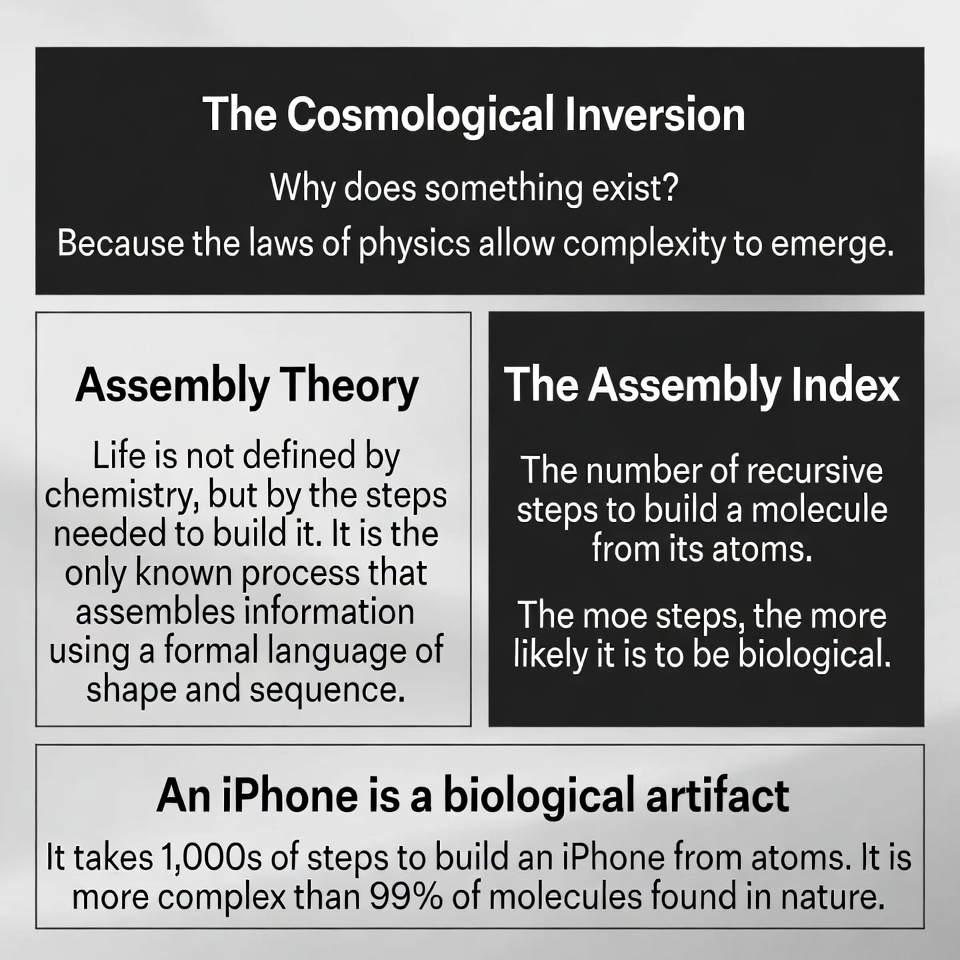
For centuries, philosophers have asked, “Why is there something rather than nothing?” Cronin proposes a subtle but radical inversion: “Why is there nothing and not something?” In his view, the universe at its baseline is characterized by randomness and entropy. Matter, in its simplest form, is “boring” governed by the repetitive, predictable laws of physics like gravity and fusion.
The “something” we observe complex molecules, organisms, and technology is the result of matter developing the ability to persist against background degradation. This is where chemistry enters the fray. Cronin describes chemistry as the “most profound thing that happened to physics.” While physics provides the stage, chemistry provides the computation. It is the mechanism by which the universe began to store information in physical structures, allowing for the emergence of causation. In this framework, existence is not an accident but an inevitable outcome once matter gains the capacity to remember its own successes through recursive assembly.
2. Assembly Theory: Redefining Life through Complexity and Scale
The traditional search for life, whether in the fossil records of Earth or the clouds of Venus, often relies on “biosignatures” specific gases or structures we associate with biology. Cronin argues this is too narrow. Instead, he focuses on what life does: it creates complex objects recursively and at scale.
The Assembly Index
Assembly Theory quantifies this via the “Assembly Index” (AI). This index measures the shortest path of recursive steps required to build a molecule from its basic components. A simple molecule like water has a low index; a complex protein or a pharmaceutical drug has a high index.
However, complexity alone is not enough. A single complex molecule could be a statistical fluke. But when you find a high-complexity object produced at scale meaning millions of identical copies you have definitive proof of a causal, evolutionary process. This is the hallmark of life.
The iPhone as a Biological Artifact
In perhaps his most provocative comparison, Cronin argues that an iPhone is “life.” While we see it as a piece of technology, Assembly Theory views it as a biological artifact. An iPhone cannot be formed by the random collision of atoms in a vacuum, even over trillions of years. Its existence requires a four-billion-year unbroken chain of biological evolution, culminating in a specific designer (the human mind) and a global manufacturing infrastructure. The iPhone is the physical manifestation of a massive amount of “causal history.” By this definition, our technology is not separate from life; it is the current “high-water mark” of the biosphere’s complexity.
3. The Causal Chain: Why AI is Missing the Ladder
A central pillar of Cronin’s critique of modern AI is the “hierarchy of emergence.” He posits that intelligence is the result of a specific sequence of evolutionary milestones, most of which current Large Language Models (LLMs) have entirely bypassed.
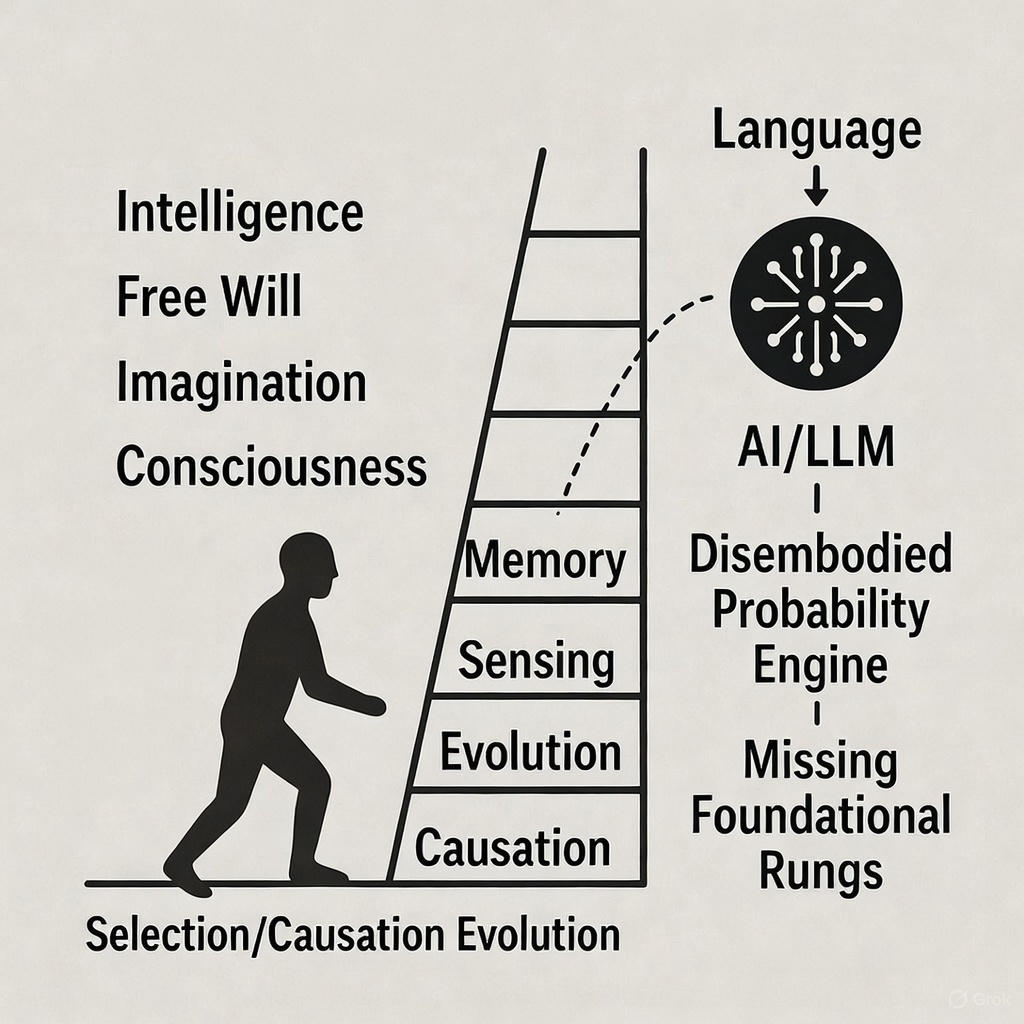
1. Selection/Causation: Matter persists against the environment.
2. Evolution: Systems gain feedback loops for survival.
3. Sensing: The move to multicellularity and real-time environmental interaction.
4. Memory: Storing past interactions to inform future ones.
5. Consciousness: Real-time awareness and internal access to memory.
6. Imagination: The ability to simulate “possibility space” to predict outcomes without physical risk.
7. Free Will: Choosing between simulated futures.
8. Intelligence: The tool used to solve problems in real-time using all the above.
9. Language: A symbolic representation of internal states used for cooperation.
Cronin notes that LLMs like GPT-4 start at the very top of this ladder Language without having any of the foundational rungs (Evolution, Sensing, Agency). Because they lack the drive for survival and the capacity for sensing the physical world, they are “disembodied probability engines” rather than intelligent agents.
4. The Silicon Deadlock: Probability vs. Possibility
The debate over whether AI can become “superintelligent” often hinges on the speed of silicon processors. Cronin argues this is a category error. He distinguishes between Probability Space and Possibility Space.
- AI (Probability Space): Current AI is a “search tool” that mines the past. It looks at the massive corpus of human data and predicts the next most likely token. It is a probabilistic representation of what has already happened.
- Intelligence (Possibility Space): Human intelligence is the ability to conjecture entirely new things that have no prior data. Cronin cites Elon Musk’s engineering feat of landing a rocket on “chopsticks” (the Mechazilla arms). There was no training data for this; it was a leap into the “possibility space” driven by imagination and physical intuition.
Furthermore, Cronin highlights a physical limitation: the human brain is a morphing, continuous chemical system. With 120 trillion neurons and 10,000 connections each, the “configurational space” of a human brain is larger than the number of atoms in the observable universe. A static silicon chip, which samples the world in binary steps, cannot mimic the fluid, continuous reconfiguration of biological matter. For Cronin, the gap isn’t just software; it’s the fundamental medium of computation.
5. Deconstructing the “Doomer” Narrative
In the realm of AI ethics, “Doomers” like Eliezer Yudkowsky warn of an AGI (Artificial General Intelligence) that might “wake up” and decide to eliminate humanity. Cronin dismisses these fears as “scientific magic.”
He compares the fear of rogue AGI to a fear of “Anti-Gravity.” One can construct a terrifying narrative about the world floating away into the void, but without a physical mechanism for anti-gravity, the fear is unfounded. Similarly, Cronin argues that AI Doomers have failed to provide a mechanism by which an LLM a system with no biological drive, no agency, and no “wish” to survive could develop the intent to take over the world.
Real vs. Imagined Risks
Cronin argues that by focusing on “X-risk” (extinction risk), we are ignoring the very real, immediate dangers of AI:
- The “Bullshitting Tool”: AI is exceptionally good at generating plausible but false information, leading to the erosion of truth.
- Social Manipulation: The use of AI chatbots as addictive therapists or political influencers.
- Irresponsible Human Use: The risk isn’t the AI “waking up”; it’s humans using “magic-sounding” tools to cause real-world chaos.
6. Future Frontiers: Astrobiology and Chemical Computers
Cronin’s work extends far beyond critique, offering two transformative paths for future research.
Astrobiology and the Dragonfly Mission
Assembly Theory provides a universal “life detector.” Unlike previous methods that looked for specific Earth-like chemistry, Cronin’s approach uses mass spectrometry to look for any complex molecule that exceeds a specific assembly threshold. This methodology will be crucial for NASA’s Dragonfly mission to Titan. If we find molecules with high Assembly Indices on Titan, we have found life, regardless of whether that life is carbon-based or follows the “central dogma” of Earth’s biology.
The “Chem-Machina” (Chemical Computers)
To bridge the gap between silicon and biology, Cronin is developing “Chemical Computers.” These are systems where bits are not electrical pulses in a chip, but chemical oscillations in a 3D grid or “brain gel.” By creating a computer that is chemical and morphing, Cronin hopes to see if a synthetic system can finally develop the “agency” that silicon lacks. This is not about building a better LLM; it is about recreating the physical conditions that allowed intelligence to emerge from the primordial soup.
7. Historical Context and Future Speculation
Lee Cronin’s vision can be compared to the Copernican Revolution. Just as Copernicus showed that the Earth is not the center of the universe, Cronin is showing that human intelligence is not a “magic spark” but a predictable outcome of high-complexity chemistry.
Looking forward, if Assembly Theory is proven correct, it will revolutionize:
1. Medicine: We will be able to “program” chemistry with the same precision we program software, leading to “Chemify” a platform for the automated synthesis of any molecule.
2. AI Regulation: Policies will shift from fearing “Skynet” to managing the “informational pollution” created by probabilistic models.
3. The Search for Extraterrestrials: We may discover that the universe is teeming with “life,” but it might look like complex chemical plumes or planetary-scale artifacts rather than “little green men.”
Conclusion
Lee Cronin’s work serves as a sobering cold shower for the “AI hype” cycle. By grounding the definition of life and intelligence in the physical reality of chemical causation, he exposes the current limitations of our digital tools. His message is clear: intelligence is not a matter of processing power, but of causal history and biological agency. As he succinctly puts it, “Living systems have agency and AI has none… They are nothing compared to living systems. They are zero.” Whether or not we agree with his total dismissal of AI potentiality, Assembly Theory provides the most robust framework yet for understanding the “something” that makes our existence so profoundly different from the “nothing” of the void.